
Graemalytics: THE IMPACT OF JAKE SANDERSON
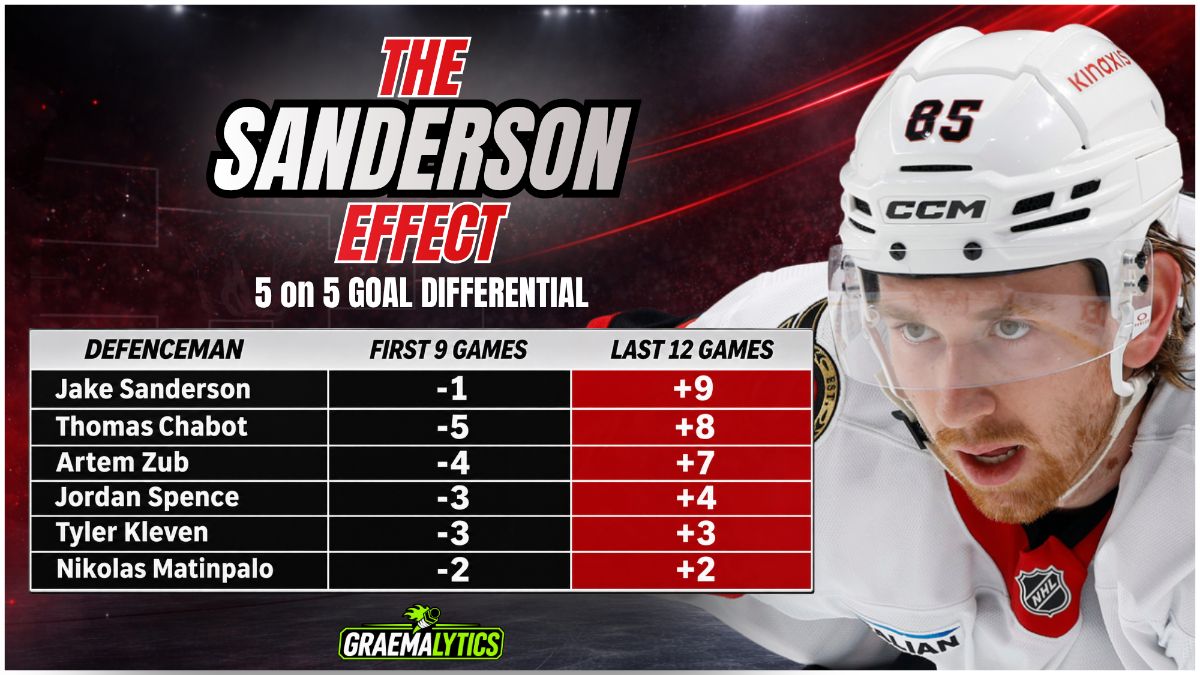
Jake Sanderson's return has had major positive effects on the rest of the Senators' defensive corps.

Co-host, Coming In Hot
4 min read
In this story
7 playersThe Ottawa Senators were one of the NHL's worst five-on-five teams through their first nine games.
Twelve games later, they're among the league's best.
So what changed?
Jake Sanderson returned.
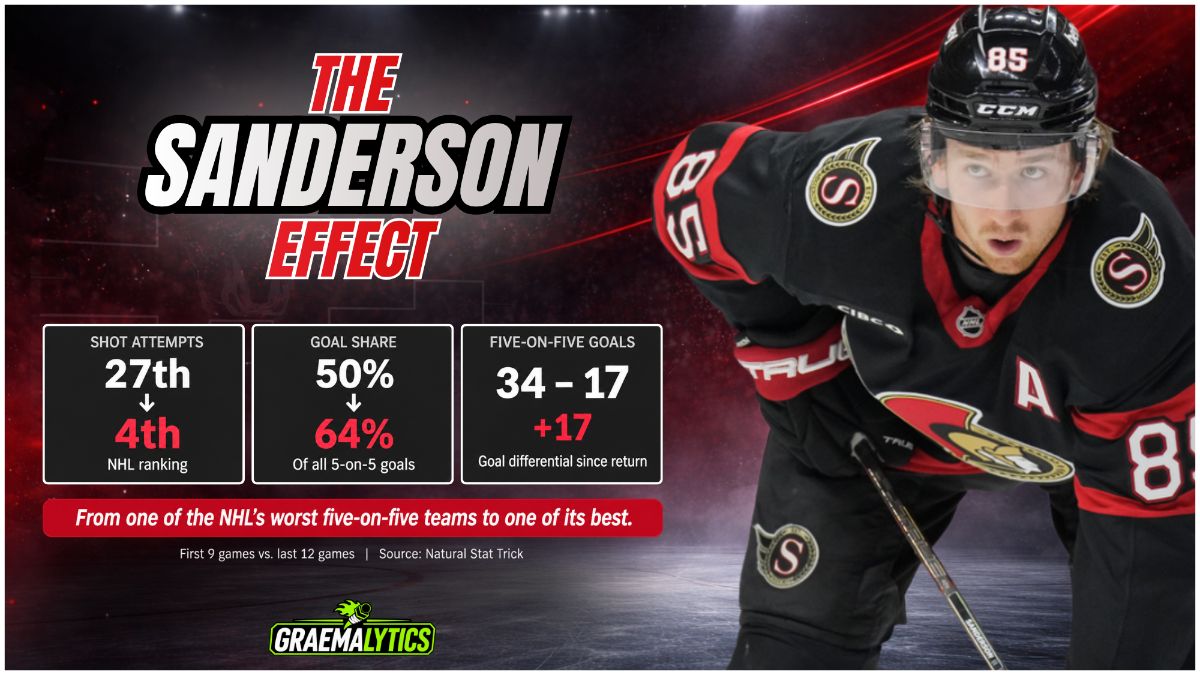
Since the 23-year-old defenceman rejoined the lineup on October 21, Ottawa has gone from 27th to fourth in shot-attempt share and from 26th to 11th in expected-goals share. The Senators have also outscored opponents 34-17 at five-on-five over that stretch.Sanderson's return hasn't just given Ottawa its best defenceman back. It's helped transform the entire blue line.
It's easy to run out of superlatives when describing Sanderson.
The smooth-skating defenceman draws comparisons to Hall of Famer Scott Niedermayer, not only for his skating ability but also for his ability to control the game at both ends of the ice. Like Niedermayer, Sanderson is humble and quick to downplay his talent.
But his importance to the Senators has become impossible to ignore.
Sanderson re-aggravated a lower-body injury during Ottawa's season opener against the Toronto Maple Leafs, playing just four and a half minutes before leaving the game. He would miss the next eight games, and the impact of his absence was significant.
Through those first nine games, the Senators struggled to control play at five-on-five.
According to Natural Stat Trick, Ottawa ranked near the bottom of the NHL in several key categories.
First nine games:
- Shot attempts (CF%): 44.01% - 27th
- Shots on goal (SF%): 46.15% - 28th
- Goals (GF%): 50.00% - T-16th
- Expected goals (xGF%): 45.39% - 26th
Last 12 games:
- Shot attempts (CF%): 53.80% - 4th
- Shots on goal (SF%): 53.09% - 6th
- Goals (GF%): 63.83% - 4th
- Expected goals (xGF%): 52.85% - 11th
The turnaround has been remarkable.
But the biggest impact of Sanderson's return goes beyond his individual performance.
It has allowed head coach Travis Green and assistant Nolan Baumgartner to put the rest of Ottawa's defencemen in positions where they can be more successful.
Early in the season, injuries forced the coaching staff to rely on 10 different defencemen. Players were asked to take on bigger minutes and responsibilities than originally anticipated.
With Sanderson back alongside Artem Zub, Ottawa's top defensive pairing was reunited.
Thomas Chabot's return from injury eventually allowed Jordan Spence to settle into a second pairing with him, while Tyler Kleven and Nik Matinpalo could return to more manageable roles.
The difference has been significant.
Consider Kleven.
During the first nine games, the 24-year-old averaged 21:11 of ice time, with the Senators controlling just 36.21% of expected goals when he was on the ice at five-on-five.
Over the last 12 games, his ice time has dropped to 17:32, while his expected-goals share has climbed to 52.97%.
That's a dramatic improvement.
Spence has experienced a similar turnaround.
His average ice time has dropped from 22:24 to 19:26, while his expected-goals share has improved from 52.30% to 58.57%. Ottawa has also controlled 88.24% of the goals scored with Spence on the ice during the recent stretch.
Chabot's numbers have improved as well.
After averaging 25:20 through the first nine games, he's now playing 21:59 per game. His expected-goals share has jumped from 49.35% to 60.08%.
The numbers paint a clear picture.
With a healthier blue line, Ottawa no longer needs to ask its depth defencemen to play top-four minutes, while its top two pairings are better equipped to handle the opposition's best players.
Sanderson's return has been central to that change, although Chabot's return and the emergence of more stable defensive pairings have also contributed.
The results are beginning to resemble what the Senators accomplished last season, when they were among the NHL's strongest teams at five-on-five.
And with strong goaltending behind them, Ottawa has outscored its opponents 34-17 at five-on-five over its last 12 games.
That improvement has helped push the Senators into a share of first place in the Atlantic Division with 28 points.
Perhaps the most encouraging part is that Ottawa has managed to climb the standings without consistently playing its best hockey.
There have been stretches of strong play, but the Senators have yet to put together the kind of sustained performances they're capable of producing.
Special teams remain a concern, with neither the power play nor penalty kill operating at the level they enjoyed last season.
That leaves considerable room for improvement.
For a team already sitting near the top of its division, that's an encouraging thought.
The Senators have shown they can win games without everything clicking. If they can find more consistency and get their special teams back on track, they have the potential to establish themselves among the NHL's elite.
And while there are several reasons for Ottawa's turnaround, the return of Sanderson has provided the foundation.
Sometimes the biggest impact a player can have isn't just what he does on the ice.
It's how much better he makes everyone around him.