
The Jake Sanderson Paradox: Greatness Is Never Good Enough
Alex Adams goes one-on-one with the Senators star about self-doubt, mental preparation and his relentless pursuit of improvement.

Co-host, Coming In Hotter and host, The Hot Seat
4 min read
In this story
3 playersYou’d never guess it from his effortless play, but even Jake Sanderson suffers from imposter syndrome.
“I take pride in my defensive game, but at the same time, I feel like I have so much to get better at. It's kind of that imposter syndrome.”
To perform at their best, some athletes need to find that chip on their shoulder.
“I think about it all the time,” said Sanderson about striking the balance between self-doubt and self-belief.
For Sanderson, the pursuit of improvement never stops. His points-per-game average has increased every season of his five-year career, transforming him from a highly touted prospect into one of the NHL's elite defencemen.
His progression has continued this season, as Sanderson’s analytics are impressive according to Evolving Hockey.
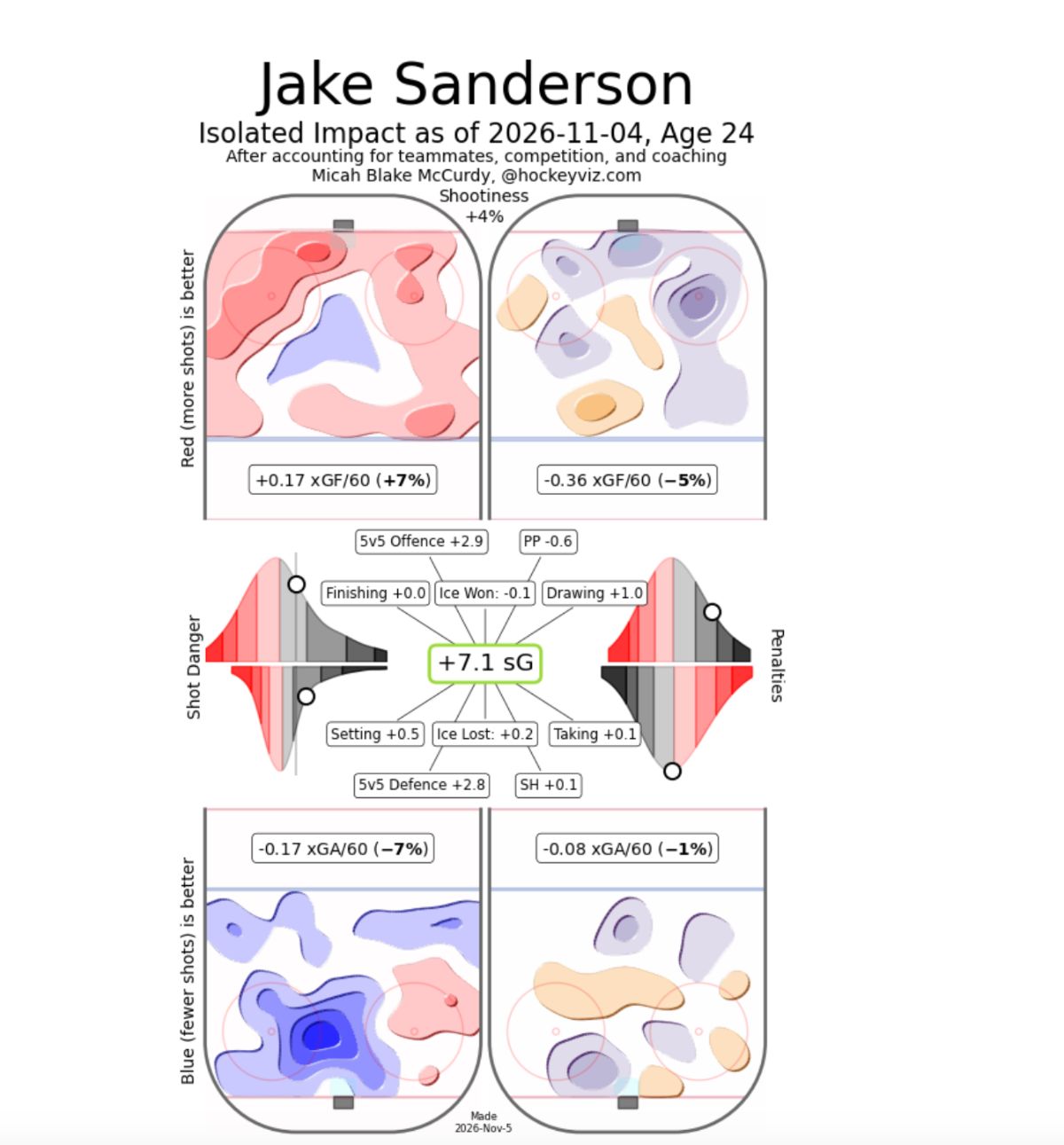
Positive in the top left indicates the offence a player creates when on the ice, and the blue in the bottom left indicates the defence in terms of offensive suppression when on the ice.
With Sanderson on the ice, the Senators are an elite offensive unit this season and exceptional defensively.
“He's extremely smart. He studies the game. He's a student of the game,” said Travis Green.
“Sandy's a guy that you really don't have to (explain his mistakes). It's very rare that you have to show him something that he doesn't already know, whether it was a mistake or something he could have done differently.”
Last season, Sanderson finished 18th in Wins Above Replacement (WAR) according to Evolving Hockey despite missing 15 games (WAR is a cumulative statistic) while finishing 10th in Norris Trophy voting.
There’s never been much doubt about Sanderson’s defensive ability. He is a silky-smooth skater that reads the game reads exceptionally well.
When Sanderson came into the league, the questions about his ceiling were primarily based on how good his offence could become.
Since the start of the 2024-25 season, among defencemen Sanderson ranks 10th in the NHL in points and sixth in power play points. Meanwhile, this season Sanderson has 10 points through nine games--but really eight games, after suffering an injury 4:39 in against Toronto opening night.
If Sanderson maintains his point-per-game pace, he could join Erik Karlsson as the only defencemen in Senators history to average at least a point per game over a full season. Karlsson accomplished the feat with 82 points in 82 games in 2015-16.
“I think not a lot, to be honest,” Sanderson told ComingInHot.ca, when asked about his improvement offensively this season.
“I mean, I’ve got one goal, so I don't think I have much to show recently on the offensive side.”
“I think I got more to show for sure.”
The confidence of the vast majority of NHL defencemen would be sky-high if they had Sanderson’s offensive start to the season, but that’s not Sanderson.
That's just who he is, a perfectionist who, over time, has learned to embrace that side of himself.
“I've been kind of told my whole life not to change,” said Sanderson.
That attention to detail extends well beyond the ice, from his recovery and nutrition to his mental preparation.
“I've changed a lot of it actually. I'm adding more, subtracting too. I'm doing different stuff,” said Sanderson about his off-ice recovery and eating habits.
Heading into this season Sanderson wanted to improve his consistency on the ice with the help of his diligence off it.
“I think when I was talking about feeling more consistent, it is more like physically,” he said. “I did some stuff all summer, and I think I feel alright. I feel pretty good, but I definitely haven't reached my best. I haven't felt my best, which I'm excited about too. So, I know I'll get there.”
The defenceman didn’t want to go into specifics, but he prioritizes his sleep and eating well, particularly on road trips. In the past, Sanderson was known for sleeping in compression pants after games for recovery.
Sanderson has drawn inspiration from Andre Agassi's autobiography, which explores the challenges of elite athletic performance, as well as stories about Michael Jordan's competitive mindset.
He's been drawn to the ancient Greek philosophy of Stoicism: it focuses on emotional regulation and accepting what you cannot control.
“I feel like you work so hard physically. But everyone says you don't really work on the mental side of the game, and obviously it's mental health, but it's also like mental preparation, manifestation, and seeing things before they happen, believing in things before they happened.”
“Before the Olympics too. I would manifest that (I’d win the Olympics). I manifested that for years.”
Sanderson wouldn't reveal what he's currently manifesting, but it's safe to assume his ambitions remain high.
Interestingly, ahead of his return from injury against Florida on October 21 during practice, Sanderson was practicing visualizing his zone exits in his own end.
“I was visualizing our face-off plays in different scenarios where the play would end up. So, when the game came, I already saw the plays before the game (in my mind).”
“I'm kind of a (hockey) nerd.”
Manifestation and visualization are important parts of Sanderson's mental preparation, but so is keeping himself grounded and never becoming too comfortable.
“Obviously, I like to believe in myself and work hard to believe in myself,” said Sanderson.
“But at the same time, I think having those thoughts and keeping yourself in check and not getting too comfortable is a huge part of your personal growth as a player. And I catch myself. I think there's been a few times this season where I don't say I'm just going through the motions, but I'm maybe not being really intent with what I'm doing, or I'm not learning. I think you always got to; you want to learn. There's so much to learn, and we're never going to learn everything.”
When the puck drops, the imposter syndrome remains on the bench.
“That's where I'm most confident in the whole world is when I step on the ice.”