

PARKER KELLY WANTED TO PROVE THE SENATORS WRONG. HE DID.
After failing to receive a qualifying offer from the Ottawa Senators, former prospect Parker Kelly has enjoyed success with the Colorado Avalanche.

Co-host, Coming In Hot
9 min read
“We won’t bat 1.000.” ~ Ottawa Senators general manager Steve Staios in an exclusive one-on-one with 'Coming in Hot'.
OTTAWA, ON -- When the Ottawa Senators decided not to give Parker Kelly a qualifying offer in the summer of 2024, the forward thought his NHL career might be over.
Two years later, Kelly became a 20-goal scorer with the Colorado Avalanche and signed a four-year contract extension.
And yes, proving the Senators wrong was part of his motivation.
“Any player who gets let go from a team, you want to show that they made a mistake,” Kelly told Coming In Hot.
The 27-year-old winger admitted he was stunned when his agent called to inform him Ottawa was moving on.
“To be honest, my life and career were flashing before my eyes,” Kelly said. “I was a bit surprised, to be honest. It stung because I really loved it here, and my wife and I wanted to stay.”
Parker's professional hockey career started from humble beginnings.
After being passed over as an 18-year-old in the 2017 NHL Draft, Kelly received a free agent invite to attend the Senators’ development camp immediately after its conclusion. The Camrose, Alberta product had finished his second season with the WHL’s Prince Albert Raiders, where he recorded 23 goals, 43 points and 75 penalty minutes in 72 games.
He obviously made a favourable impression, because he parlayed that viewing opportunity into an invitation to play on the Senators’ rookie tournament roster. Led by Thomas Chabot and Drake Batherson, that Senators’ entry ultimately won that tournament, besting the Montreal Canadiens 8-2 and outlasting the host Toronto Maple Leafs in a shootout 4-3.
Kelly contributed a goal and an assist in that first game against the Canadiens, and his strong showing led to him signing an entry-level contract as an undrafted free agent.
That contract was a crowning achievement and a story of perseverance. Kelly was a seventh-round pick in the WHL’s draft, and even at that level, no opportunities were gifted to him as they would be for higher-round picks. Everything he had, he had to work for and earn.
That determination and dedication led Kelly to improve his goals and points totals in each of his next two seasons in Prince Albert. In his third junior season, he tallied 29 goals and 59 points in 69 games before eclipsing both of those totals (35 goals, 67 points in 64 games) in his fourth and final junior season.
Kelly’s progression made him a viable pro prospect. His unmatched work ethic helped. Kelly and Mark Borowiecki remain the only two players in franchise history to have earned multiple Jonathan Pitre Awards for the player judged as the hardest worker in development camp.
He would go on to play parts of four seasons with the Senators.
Listed at 6’1” and 185 lbs, the winger was never the most physically imposing player, but his relentless compete level and his aggressive forechecking made him a pesky player that the opposition loathed.
His production never approached his junior levels, but in his last season with the Senators in 2023-24, Kelly tallied 8 goals and 18 points in 80 games. They were modest totals, but for a fourth liner who spent the entire campaign playing alongside Mark Kastelic, Boris Katchouk, Dominik Kubalik, Rourke Chartier and Zack MacEwen, the offence understandably did not play up.
More importantly, however, Kelly remained an analytics darling for the defensive value he provided.
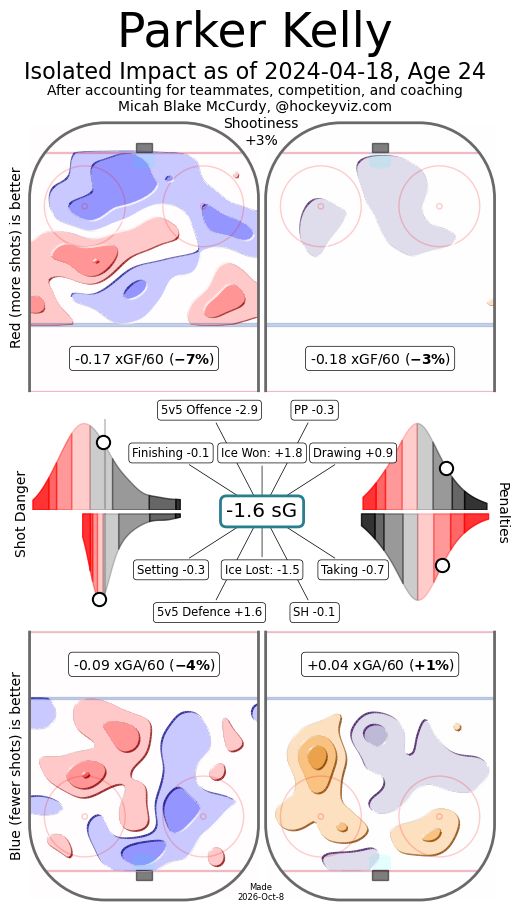
(Note: in the visual above from HockeyViz.com, the isolated offensive impact is at the top, and the isolated defensive impact is at the bottom. The percentage attached to each reflects how much better they are than the league average, and the colours represent where shots are being taken when this player is on the ice. A positive percentage in the offensive iso is good for shot creation, while a negative percentage in the defensive iso reflects better shot suppression. In terms of colouring, darker shades represent the volume of shots from that area. Blue represents fewer, while red indicates more.)
When Kelly was on the ice, his defensive impact was relatively strong for a team that needed to improve defensively. It wasn't just a one-year fluke either. His isolated defensive impact in 2022-23 was robust.
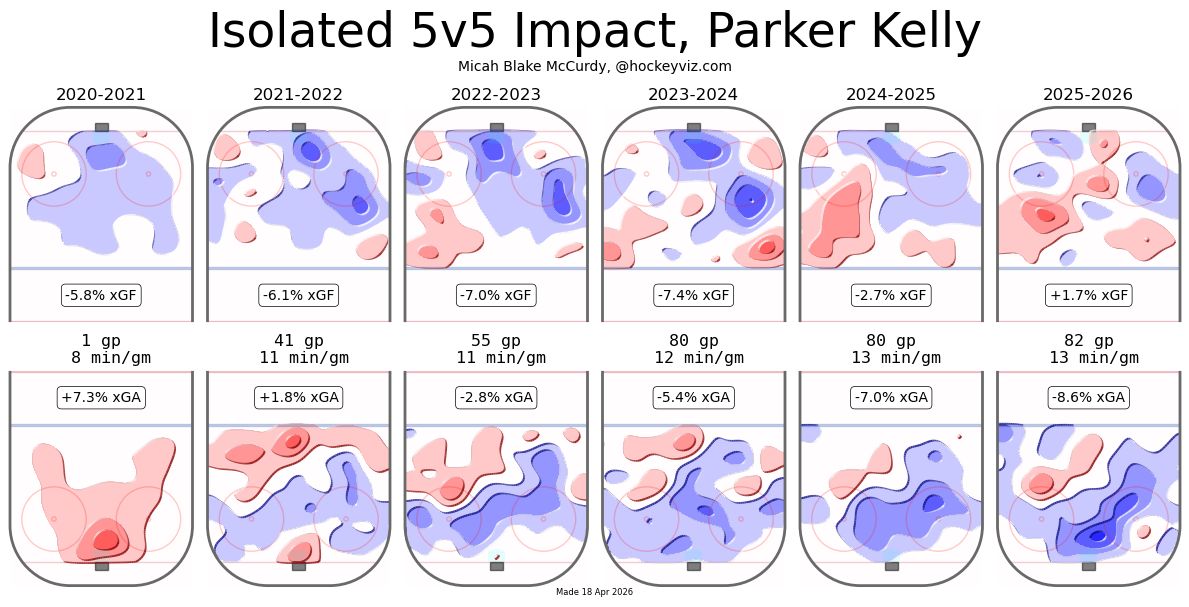
As a 24-year-old winger who had grown and developed with the rest of the Senators’ young core, he was of an age that certainly aligned with the Senators’ window of competitiveness.
Despite his status as an impending restricted free agent in the 2024 offseason, Kelly was the Senators’ designated NHLPA rep who was attending meetings in Vegas. There, two days before the opening of unrestricted free agency, Kelly received a call from his agent informing him that he would not receive a qualifying offer from the Senators.
“To be honest, my life and career were flashing before my eyes,” Kelly admitted to ‘Coming In Hot’ after the Colorado Avalanche’s morning skate. “I got the call like two days before July 1st, and I was a bit surprised, to be honest.
It stung because I really loved it here, and my wife and I wanted to stay. I remember telling my wife, ‘Well, the NHL was fun. We'll see what happens now.”
The winger would not have to wait long for the phone to ring.
Several teams expressed interest in the forward, but one quickly came to the forefront. While others expressed interest, they asked for his patience as they worked through other prospective signings first; Colorado stepped up and told Kelly he was one of their primary focuses.
“That was really a big point for my wife and me,” Kelly acknowledged. “I was the guy that they wanted to come and get, so signing felt like a no-brainer. Just look at the roster on paper, I said, ‘Yeah, I'll come join this team.’”
Colorado is also renowned as one of the more progressive front offices that has been near the forefront of the hockey analytics wave that has swept over the NHL for the last decade. If they have a strong interest in a player, there is probably well-researched and thorough reasoning behind it.
That does not mean the Senators’ decision didn't hurt, though.
“That's kind of what I was upset about,” Kelly expressed when asked about analytics and his underlying numbers in Ottawa. “At the time, I felt I was having my best year to date, and it happened after I had a bad year. I had one goal and three assists in 55 games.
“It’s not that (offence is) what it's all about, but I felt like I really worked on my offensive game. They wanted to see more from me, but I thought I was having a good enough year to build some trust with management and the coaches. I was hopeful they could commit to me for a couple more years, but they didn't see a fit.
“At the end of the day, it's a business. But I'm not gonna lie, I was a bit surprised because I felt like my game was starting to grow. I was starting to be an everyday pro NHL player and learn the ins and outs of the game a bit more. Then you get a call at the end of the summer, and they say they're going to go a different direction. You're in limbo. You don't have a team. You feel nervous, and you don't know what's on the other side of the next door.”
In Kelly’s first year in Colorado, he essentially matched the production of his final season in Ottawa, contributing 8 goals and 19 points while averaging 12 minutes and 45 seconds of ice time. He also became a key fixture on the Avalanche’s penalty kill, averaging 1 minute and 57 seconds of shorthanded ice time per game.
In the 2025-26 season, Kelly exploded for 20 goals and 35 points, while maintaining his strong defensive play. Kelly continued to average almost two minutes of shorthanded ice time while the Avalanche’s penalty kill finished with the league’s best kill rate at 84.6 percent.
Asked what changed, Kelly was extremely thankful for the Senators organization and the work that Ben Sexton, Troy Mann and David Bell put in.
The biggest difference, however, was confidence.
“I've always been a great forechecker,” Kelly said. “When I came into the league under DJ, I was still young. I wasn't playing that much, and I was just happy to be in the NHL. Then you get older and start wanting to contribute (offensively).
“How do I unlock an offensive side? I worked with the coaches, and instead of dumping it and trying to hit the guy as I did through my first 200 games, I’ve tried to hang onto the puck more and make a play with a cutback.
“(My coaches) have been really good at showing me video and showing a play where to dump it in, get on the forecheck, go hunt it. That's why I’m in the NHL. I’m a forechecker, and sometimes I delay and look for the defenceman coming up. We have so many great players here. They make great plays and can make you look better than I am at times.
“It's just little things like hanging onto the puck, making plays, and being confident with it. As you get older, you start to believe in yourself a bit more, and once you start to feel it, it's easier to believe in yourself and keep making those plays consistently.”
It would be naive to believe that the career 11.7 percent shooter can maintain last season’s 20.2 percent, but Kelly is off to a strong start this season. In 19 games, he has 3 goals and 8 points, putting him on pace for 13 goals and 35 points.
With the strong defensive metrics, that is decent value for a fourth-line player - especially since Parker is only in the first year of a four-year extension that he signed after his big 2025-26 campaign.
In the salary cap era, having inexpensive players who exceed their contract value matters. Resources are finite, and these contracts let organizations allocate more money to acquire dynamic difference makers at the top of the lineup.
To put things in perspective, with a healthy roster at the start of the season, the Senators’ fourth line featured Warren Foegele, Stephen Halliday and Fabian Zetterlund. That is a combined $7.75 million commitment in cap space to two wingers who offer similar production to Kelly. Both players offer quality depth who can play up and down the lineup, but for similar production, and given the opportunity cost (two second-round picks) used to acquire them, keeping Kelly would have saved the Senators money and draft currency.
Kelly’s performance since leaving the Senators has been vindicating.
“Any player who gets let go from a team, you want to show that they made a mistake,” he admitted. “It's what makes us good. It's what makes us click as NHL players. I would, I'd be lying if I didn't feel like, “Hey, maybe things worked out differently. I could have done this with you guys.
“So, that's what you know goes through your head. But at the end of the day, I’m happy with the way things worked out. I'm always grateful for my time in Ottawa. (Their decision) wasn't out of spite. They didn't hate me. It was just a business decision. I felt good about my game and what I was working toward, trying to build and develop with Ottawa, but it felt really good to have those last couple of years and show that I'm a great player and that I believe in myself.”
For a process-oriented organization like the Senators, which has had far more hits than misses during Steve Staios’ tenure, letting Kelly go was an uncharacteristic oversight - especially since many of their moves have targeted and improved the margins.