Exclusive: 1 on 1 with Steve Staios
Steve Staios reflects on his first 1,000 days leading the Senators, the decisions that have shaped the roster and how changes behind the scenes are helping move the franchise forward.
14 min readUpdated October 20, 2026
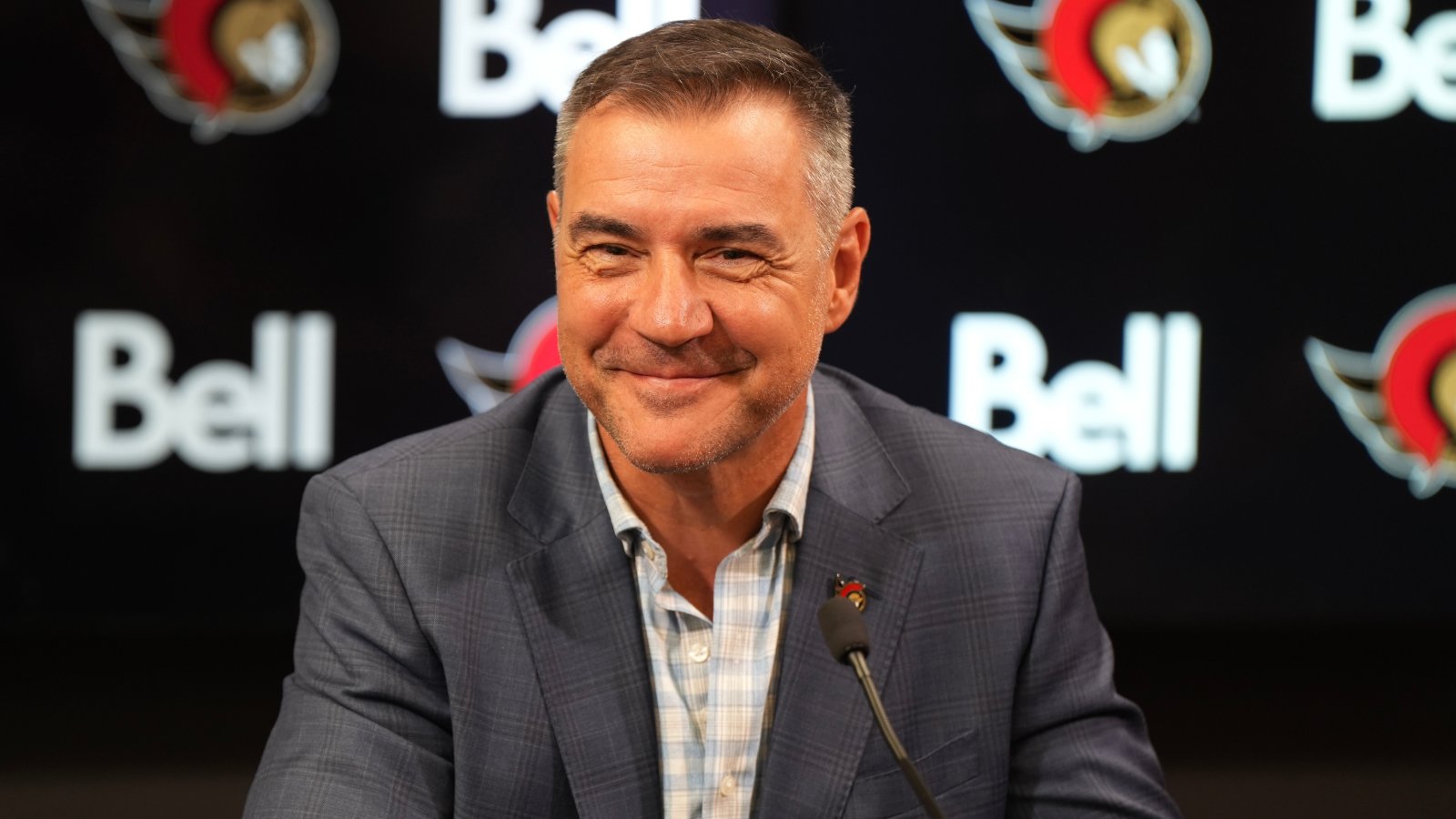
Atop the mezzanine at the Canadian Tire-sponsored ice pad at the Kanata Sensplex, Ottawa Senators general manager Steve Staios stands surveying his collection of talent at practice.
It is Staios's customary perch at the rink, and he was surrounded by other familiar faces from the hockey operations department: Dave Poulin, Tim Pattyson, and Sean Tierney.
The Senators were in the midst of their last practice before they departed on a three-game road trip through Toronto, Boston and Detroit. Given the competitiveness of the Atlantic Division and the league’s parity, there was no sense of nervousness or anxiety emanating from the general manager as he took a step away from the action to speak with me.
This temperament has become a hallmark of the Staios era.
Michael Andlauer first introduced Staios as the president of hockey operations on September 29, 2023. This announcement landed eight days after the NHL Board of Governors unanimously approved the sale of the franchise to Andlauer.
While the decision was predictable, the only surprise was that it wasn't announced sooner.
An article written by Ian Mendes in The Athletic at the time of Staios’ appointment detailed how their relationship dated back to the NHL’s 2004-05 work stoppage. During the lockout when Andlauer owned the AHL’s Hamilton Bulldogs, Staios reached out to Andlauer to ask about buying a season’s worth of tickets for a suite that he could give to underprivileged children.
From that moment, the two became good friends, and the connection eventually grew into a professional one when Andlauer hired Staios as president and general manager of his OHL’s Hamilton Bulldogs. The pair had success, capturing two J. Ross Robertson Cups as OHL champions in 2017-18 and 2021-22.
Fittingly, Andlauer brought that familiarity to Ottawa, envisioning a chance to recapture that magic and, hopefully, bring success to hockey’s highest level: the NHL.
Whenever a professional sports organization operates on a shoestring budget, the odds are stacked against it. The disadvantages are numerous. When those drawbacks are compounded by an ownership structure that accepts and normalizes distrust and self-preservation in the organization’s hierarchy, the odds of attaining sustainable success are slim.
And that is precisely what Michael Andlauer and Steve Staios inherited.
A little over a month into Staios’ tenure as president, he experienced his first controversy as a scandal hit the organization. Pierre Dorion’s failure to disclose Evgenii Dadonov’s limited trade clause with Vegas sparked a league investigation, leading to a heavy punitive measure in which the Senators were stripped of a first-round pick.
It was hardly the idyllic welcome Andlauer imagined when he bought the team.
The organization moved quickly. Following Dorion’s formal resignation on November 1, 2023, Staios became the sole caretaker of the hockey operations department before formally inheriting the general manager title on December 31, 2023.
September 26, 2026, marked his 1,000th day as the Senators’ general manager.
With no previous NHL manager experience, Staios arrived with conviction and a belief in a process that would help turn the franchise around. In his reflections on his tenure in Ottawa, it's clear the organization needed a lot of work and time to get to where it is now.
“Experience brings a little bit more comfort,” Staios stated, recalling how he felt in his formative days in the nation’s capital. “In this job, there's never really ultimate comfort because there are so many variables and moving parts, but I'd say that we're proud (of where we are now).
“For me personally, there is just a comfort level in the process. We're working much more efficiently now that I've had time to develop that within the organization.”
From the moment Staios arrived, he observed and evaluated.
“In my president's role, I looked at things in the bigger picture and looked at each department,” he explained. “I saw how each department was functioning. Some were fine, and others weren't, so I got to work making the changes necessary in those departments. Foundationally, as you make changes by bringing people in, you put them in a leadership role and put them in a process. Then, you watch. I look at (these departments) as pillars such as strength conditioning, medical, scouting, pro and amateur coaching, and evaluate from there.”
Arriving in an organization where there are so many gaps or blind spots, it would be easy for an incoming general manager, especially one without previous NHL general manager experience, to be overwhelmed or question where to begin.
For Staios, patience was essential.
“(Patience) is the only way that I know how to do it,” Staios asserted. “I want to make sure that, in particular, when you're talking about these pillars and these areas of the organization, rushing to judgment is not the right thing to do. A rush to judge the people that you have involved (is risky).
“For me, I've always taken the time to look at a process to put in place and allow the people that were there to function within it, and then be able to fairly evaluate.”
The Senators knew they had a young core with unrealized potential. They just did not have full confidence they would reach it without burning several of their best and most cost-effective years.
“When I talk about our roster, one of the questions I had the most in that first year was, 'Is this core group good enough?’, Staios revealed. The honest answer was, I didn't. No one knew because the players didn't have a chance to really show what they're all about.”
It was about affording this group an opportunity.
The Senators had a clearly defined group of young players on the roster, but Staios recognized he needed to insulate them. Insulating them in the sense that they needed to be surrounded by good pros who could not only help from an on-ice perspective, but could lend their leadership and experience to help organically grow a culture and environment they needed to succeed.
Off the ice, Staios and Andlauer worked to add elements the organization lacked. Before the sale of the Senators was finalized, Sean Tierney was hired as the Senators’ director of analytics. He represented the first full-time analytics staffer in the organization’s history. Tierney came to the organization from Sport Logiq, but was familiar to the Senators’ new owner and president. He held the same position while working for them as part of the OHL’s Hamilton Bulldogs.
Renowned in hockey circles for his expertise in offseason player performance training, Matt Nichol was hired as the director of player health and performance. Sam Gagner was hired in 2025 to be the Senators’ director of player development. To help manage the front office workload, Dave Poulin and Matt Turek were brought in as the senior vice-president of hockey operations and the general manager of the Belleville Senators, respectively.
As a former player, Staios wanted to afford his group time.
“Once you surround the players with all these different pillars of the organization, and put them in place, then you have a proper evaluation,” he emphasized. “I haven't lost the player in me. You feel like you want to give a fair shake, and to be able to do that obviously takes a bit of time.”
They just needed a coach.
Systemic losing impacts the psyche and habits, and with any young, impressionable group, it is easy to wonder what the long-term effects are and whether its adverse effects will prevent players from reaching their full potential.
The Senators were no different.
Under head coach DJ Smith, the team employed a run-and-gun style that fostered bad habits. Players cheated in the defensive zone to chase offence.
“Jacques Martin, it was a very strategic move to bring him in,” Staios stated. “In terms of just learning how to be a pro, who better to portray that message initially? In the details that Jacques coached, he's methodical. He's detailed. That was the first step in laying the foundation of the coaching pillar, and it helped set the table for Travis (Green).”
Since the start of the 2023-24 season, the Senators’ five-on-five shot and expected goal share has improved every season per Evolving-Hockey.
- 2023-24: 49.82 CF%, 50.05 SF%, 49.14 xGF%
- 2024-25: 50.25 CF%, 50.36 SF%, 50.16 xGF%
- 2025-26: 53.47 CF%, 54.63 SF%, 55.41 xGF%
They improved to a point last season that the Senators finished in the top five of the league in shots for (CF%), shots on goal (SF%), and expected goals (xGF%). It took time, but the organization instilled structure and accountability in a group that previously had none. They now have an identity as one of the best defensive teams in hockey.
“When I hired Travis amongst a group of very good candidates as I went through the interview process, (team defence) was the one (separator), from a coaching perspective,” Staios recalled. “That was the one core, foundational piece that he's been very consistent on as a coach, through the minors.
“The initial thing when you look at a coach, people say, well, look at the win-loss record, but when I took the deepest dive into it, you have to evaluate the coach on also the roster and the situation, average age, all of that, to be able to make the right decision. Going back to your point on team defence, Travis separated himself from the group in that regard, and there were many other attributes that, as I got to know Travis through the process, really encouraged me. He runs towards coaching. He's never dismissive. There are always challenges, and he moves towards them, and he leans into them. That was another key attribute for me, particularly with a group of young players who were at a very impressionable stage.”
Facilitating change cannot occur without proper buy-in, and fortunately for Staios, the young core cooperated.
“We're extremely lucky as an organization, as management, as coaches, and as fans to have this type of core,” Staios enthusiastically stated. “We can evaluate the talent of these players, but the actual character of these guys is important. They want to win.
“They're a team-first type of group, and that's not always the case. We're very lucky, and that's the greatest opportunity as we see this group continue to grow. They've always bought in to get better. They needed a coach to hold them accountable. They needed the support around them to be able to take that next step, and we're entering that phase now where it's time they've had (improvement) for a couple of years, and they're ready to take that next step.”
Taking that next step is the important one, and if there have been any loud criticisms of the Staios era, they rest in the general manager’s actions.
A glance at the Ottawa Senators’ opening-night roster for the 2023-24 regular season reveals that only seven players (Stutzle, Batherson, Giroux, Greig, Sanderson, Chabot, and Zub) remain from that team. Despite that changeover, two consecutive playoff appearances and strong underlying metrics suggest this is a strong team when healthy, but a sect of the fan base has grown weary of a front office that keeps buying low on upside plays.
To date, Staios’ biggest splash was the Linus Ullmark trade, but fans yearning for more splashy big-name moves, especially recently as the team tries to separate itself as a Cup contender, have been inevitably disappointed.
Of course, when Staios inherited the team, all of the organization’s best young talents had graduated to the parent roster. Shortsighted deals involving poor fits and name talents robbed the Senators of blue-chip prospects and draft currency to develop or trade to insulate this roster.
The Senators continue their due diligence and process-driven approach, but without disposable, valuable assets, they have had to rely on working the margins.
“That's exactly that's the approach,” Staios agreed. “A lot of big names this offseason that we were looking at and digging in on, maybe that does come (later on). The interesting thing is when Michael Andlauer asks me, ‘Are we better than we were a year ago?’ He looks at it that way. Looking back to day one in almost three years or whatever it's been, look at how far we’ve come.
“I appreciate the patience because there hasn't been a lot of big names or anything like that, but clearly, the process is moving in the right direction.”
Progress and improvement in the quality and depth are unmistakable, but the pushback on recent moves has merit too. With the young core in its prime and the team's strengths in its defensive structure, blue-line talent, and young centre depth, now is the time to add higher-calibre talent.
Not surprisingly, the response to the additions of Andre Burakovsky and Sam Ersson drew criticism.
“When I made the deal for William Eklund, it was early, and I still had room to make other deals,” Staios said while explaining the criticisms of the Burakovsky trade. “I can understand if I'm a fan asking, 'Why don't you wait?’
“You have all these other names (in trades), but you have to remember two things. One is we think he certainly has the potential to be what we hope he is within our environment, at a very low acquisition cost. The second part of it was timing. I made a big trade to move (Brady Tkachuk) out, so I think the timing wasn't good for Andre because Brady gets moved and he comes in. He didn't have a very good back half of the season. The pushback probably came from a couple of those reasons. Ultimately, we'll see. We were highly encouraged by his play through training camp, his ability to transition the puck, and his ability to play with top players. He's got great sense, but he has to come in and prove himself because we have other players on the roster who can certainly push for that spot. We thought it was a very low-key, calculated move.”
Although his acquisition cost was low and his real salary ($3.75 million) is less than his $5.5 million cap hit, that will not stop the second-guessing if Burakovsky’s production levels fall short of expectations. The concerns are reasonable, and it is easy to wonder if that cap hit could have been reallocated to a better player.
The second move that drew criticism was the trade and signing of goaltender Samuel Ersson.
At the end of his end-of-season media availability, Staios acknowledged that his handling of the backup goaltender position last year was one of his biggest missteps, realizing that it failed to insulate Linus Ullmark and put rookie goaltender Leevi Merilainen in a difficult position.
In consideration of that admission, the decision to sign one of the worst statistical goaltenders of the last two seasons represented another incurred risk. Ersson had the fifth-lowest goals saved above expected rate in the NHL last season and had the league’s lowest mark in 2024-25.
Through the preseason, it was obvious that Ersson has a blend of athleticism and size. Conversely, if the results continue to underwhelm, isn’t there a point where the results outweigh a player’s innate skill set?
“It was a long discussion and not just with Maciej (Szwoch), but with (Justin Peters),” explained Staios. “Petey's watched this guy. He said, ‘I would be extremely excited to work with this. The talent is there.’
“Is this a question of, ‘If we put him in our environment with our coaching staff, and give him the support, can he realize his talent? It's a low-risk move. It's a low-cost move that lets us do other things on the roster. There are other things in goaltending as well. The relationship between the starter and backup is one that you can't quantify. And as much as we want to dig in on the numbers, and I do think that that's something that we've done very well because we're extremely data-driven to look at opportunities. Yet we do take a step back and really ask questions about some of the unquantifiables, because there are times and moments and discussions within our process where there's clearly a move that would support the data better, and I'll make the decision. The more we dug in on this one, there was something there.”
To the organization’s credit, Ullmark has started 2025-26 playing incredibly well. His 9.42 goals saved above expected is the league’s second-best mark behind Boston’s Jeremy Swayman. When the same goaltender has failed in each of the last two years to start strongly, and openly admitted last season to battling mental health issues, catering to him to make him feel more comfortable makes sense. Adding a fellow countryman and a familiar batterymate, who played with Ullmark in the Four Nations Face-Off with Sweden, fits.
Ullmark’s early results certainly speak volumes, and he appears comfortable and is enjoying the game again.
If the moves don’t work out, Staios is comfortable facing criticism.
“There's always heat on me,” he stated. “It's always on me, and I appreciate the position. At the end of the day, I'm the guy who sits in the chair and makes the final call, and I don't point fingers. It's the position, and I’ve got no problem with it.
“We feel comfortable with our process. Are all of our decisions going to turn out? No, it's impossible, but as long as we hit on the majority of them, we'll move this thing along, and thus far, we've been able to do that. Of course, there are going to be plenty of times where there is deserved criticism on a decision that we've made, but we won't bat 1.000. As long as we can keep getting the bat on the ball and keep the runners moving, that's the goal here.”
Front offices never bat 1.000. The Senators should have fired Pierre Dorion immediately after the ink was dry on the finalized sale of the Senators. Despite strong underlying metrics, the Senators did not present a qualifying offer to Parker Kelly during the 2024 offseason, making him an unrestricted free agent who has since thrived in a depth role in Colorado. It can be argued that the reasoning was sound, but the Senators sold low on Jakob Chychrun. Fabian Zetterlund has provided depth scoring to the fourth line, but he has failed to drive play or prove himself as the reliable top-six winger the team hoped he was.
Most of his transactions have had positive results, however, and the team’s progress speaks to that.
“I appreciate questions on the roster because that's the finished product. That's what we all see, and we have to win games in the National Hockey League. But what we can be most proud of is that 80 percent of managing is not the roster, the cap or identifying players.
“We do that, and we're diligent on it. But it's the day-to-day operations and making sure things are moving the right way. It is an overused word, but that's the ‘culture’. It is the care that we put into it, the lines of communication, and the high level of accountability. We have compassion for all of our employees and our players.”
That systematic, measured approach the organization adopted after Michael Andlauer purchased the team is the process. It is the process and duty of care that fans endlessly clamoured for during the tumultuous Melnyk era.
Now that it has arrived, we’re all anxiously awaiting the big splash and that next step to take the franchise to the next stage in its development curve.