
SMALL DETAILS, BIG RESULTS FOR THE SENATORS
From sustained offensive-zone pressure to a perfectly executed faceoff play, the Senators showed how the little things can make a big difference.

Co-host, Coming In Hot
5 min read
In this story
5 playersOne distinctive element of hockey is that not everything shows up in a box score or on an events page.
One shift bleeds into the next, and unless something consequential happens, many often fade into the ether.
In a tightly contested game, such as the Ottawa Senators’ 2-1 win over the Buffalo Sabres on Wednesday night, it is easy to forget about the conclusion of the Senators’ penalty kill halfway through the third when defenceman Jordan Spence was serving a minor for boarding.
After he returned to the ice, Spence eventually headed to the bench for the change. As is often the case when the Senators finish a kill, they tend to use a nontraditional combination of players to account for the personnel on the ice playing special teams. Tim Stützle remained on the ice, but Claude Giroux and Stephen Halliday replaced Michael Amadio and Spence, respectively, while Nik Matinpalo and Carter Yakemchuk jumped on for Jake Sanderson and Artem Zub.
Together, the group proceeded to own the puck in the offensive zone, preventing Buffalo’s power play unit from getting off the ice. More importantly, their defencemen jumped in to help carry the puck down low, helping the Senators maintain puck control and establish more zone time, eventually culminating in an icing.
On its own, it may be a nondescript shift for the casual hockey fan, but the sequence kept the Sabres’ power play unit trapped in their own end defending for almost a minute and a half.
For a puck possession wagon like the Ottawa Senators, it is precisely the type of shift that they look for.
“We have a lot of shifts like that throughout a game,” head coach Travis Green told Coming In Hot. “ If you can continue it right into the third period and right through the game (it’s ideal).
“There are moments where you're playing to the score, but our mindset is always that we want to be an aggressive team. A big part of it is our defence killing plays, and not just killing them in our zone, but killing them in the offensive zone.”
The belief is that, even if the Senators do not score, they can fatigue their opponent, creating residual benefits later
“We take a lot of pride in suffocating teams and spending a lot of time in the zone,” Thomas Chabot explained. “Usually, when we put the puck behind them, our forecheck's so good that most of the time we end up taking possession of the puck at some point.”
Whether it's something simple like smart, fast changes of possession in the offensive zone, head coach Travis Green preaches the importance of the small details. They can often add up and help make a difference over the course of a game. Another key part of that mindset is encouraging all their defencemen to jump in and make plays.
“We want our (defencemen) to be aggressive and keep pucks alive in the offensive zone,” Green reiterated. “It's part of how we play, but you've got to have real commitment from your forwards to be getting above (the puck) for your (defencemen) to feel comfortable doing that.”
It would have been easy for the Senators’ third pairing to play it more conservatively. Nikolas Matinpalo is more of a traditional defensive defenceman, while rookie Carter Yakemchuk has been a regular healthy scratch of late and may not have played at all Wednesday night if Tyler Kleven never felt ill.
Playing conservatively would be understandable for a rookie trying to earn his coach's trust, or for Matinpalo, who knows he is out there with an inexperienced offensive defensive partner. Instead, both defencemen spent time with the puck down low, sustaining that valuable zone time.
“(Matinpalo)'s such a good skater and powerful guy that he's capable of doing that,” Green stated while praising Matinpalo’s development. “It's an area that's really improved in his game over the last few years.”
Chabot echoed his coach’s comments.
“You want every (defenceman) to be part of it, and yes, (Matinpalo) is more defensive, but he can still skate. He can still make plays. He's got a hell of a shot, so it's nice to see. Even more this year, we are seeing more out of (Matinpalo). He has a bit more of that confidence in getting involved and making plays.”
Conversely, Yakemchuk cannot afford to play timidly and make mistakes.
“Obviously it's his first year in the NHL, and some nights he might not play,” Chabot said. “But you can't let that beat you down. The kid's so talented, and he's going to get his shot.
“It is nice to see him come back in the lineup and still have his swagger and go out there and make plays. That's what you want out of him. You don't want him to come back tight, force plays, or not play his game. He's 21 years old. You want him to go out there and be himself.”
The benefits of this shift were felt immediately.
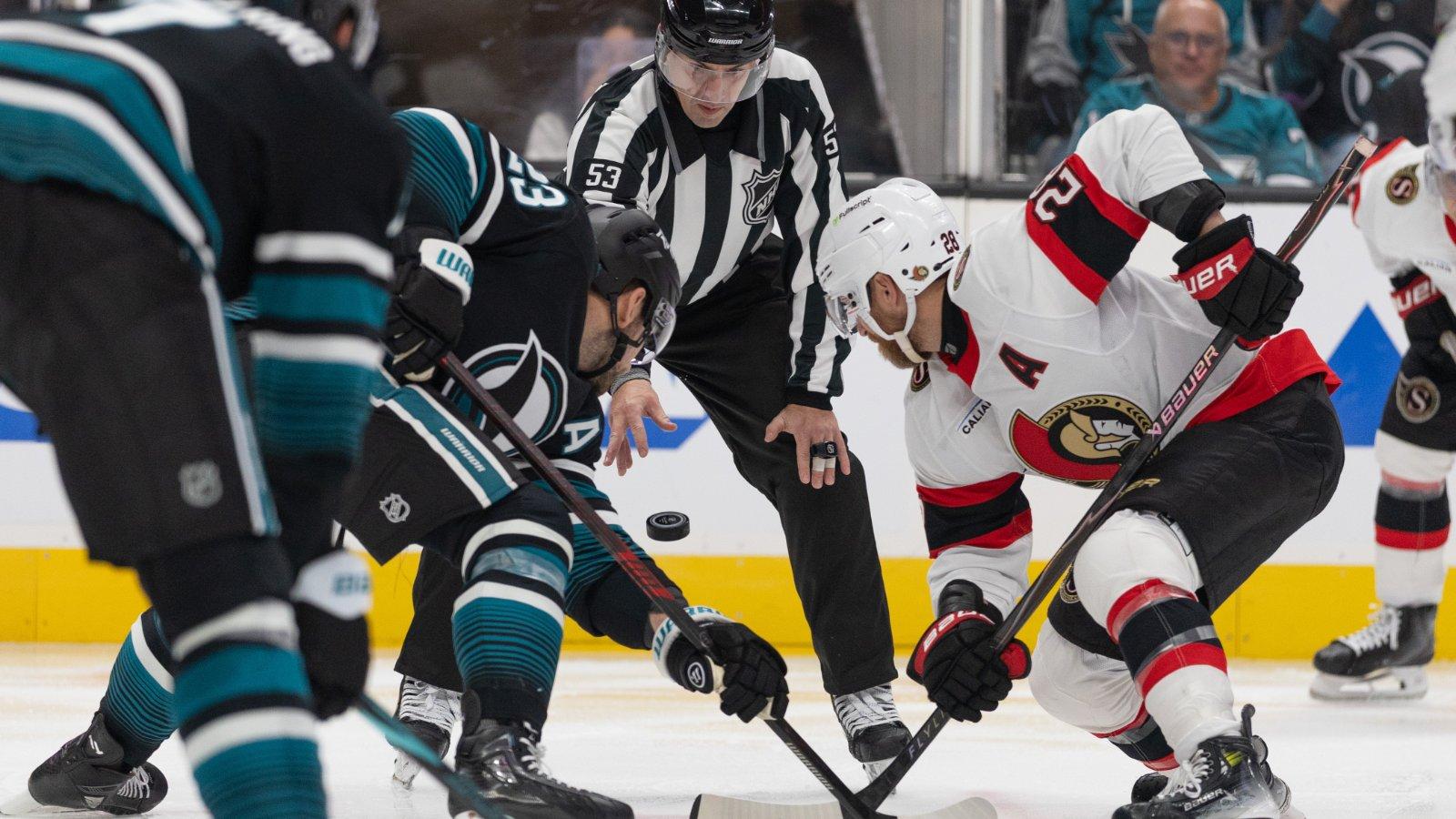
Shane Pinto won the faceoff, snapping the puck back quickly to Chabot on the right point. Thanks to his handedness, Chabot had a great view of the middle of the slot where Philip Tomasino got lost in coverage off the draw. A rebound off Tomasino’s backhander left Pinto with a yawning cage to get the Senators on the board and draw even.
Remarkably, the same set play occurred in the following game at another critical juncture.
With the score tied 2-2 with two minutes and 18 seconds left in the third, Pinto lined up for another right faceoff draw in the offensive zone.
"Chabby just said, 'Go back post off the draw,'" Nick Cousins recalled, breaking down how the play came to fruition. "Then what do you know, back post was right on my tape. That's why I was fired up after because I can't believe that actually happened. It was crazy. He just called it out.
"It's rare that you see a play work out twice, twice in like such a short time. It's one of those plays where they had the (defenceman) lined up behind the center, so he has to come a long way for the left winger, so (Chabot) called it off the draw. It's a great heads-up play by Chabby. He just says go back post, and it's on my tape. It was crazy. If Shane (Pinto) doesn't win the draw, the play doesn't happen, and then it probably goes OT where anything can happen."
The coaching staff discusses tendencies and opportunities to exploit with their players, but the players will often talk amongst themselves on the bench or before a draw to set up a play. Thomas Chabot often doesn't get the credit he deserves, but in this instance, Green wanted to make sure his veteran got his due.
"Chabot actually noticed that in the Buffalo game and talked about it throughout the game earlier," Green said. "Then they did it again, so Chabby's helping run that. He's responsible for those (goals)."
In a league featuring so much parity, it is no wonder that the Senators preach the importance of the details.
Over the last week, we saw how much they matter.