
TRICK OR TREAT? SENS' HOT START HAS HISTORY ON their SIDE.
The Senators are closing in on a rare October milestone, and history suggests their hot start could be a sign of bigger things to come.

Co-host, Coming In Hot
6 min read
In this story
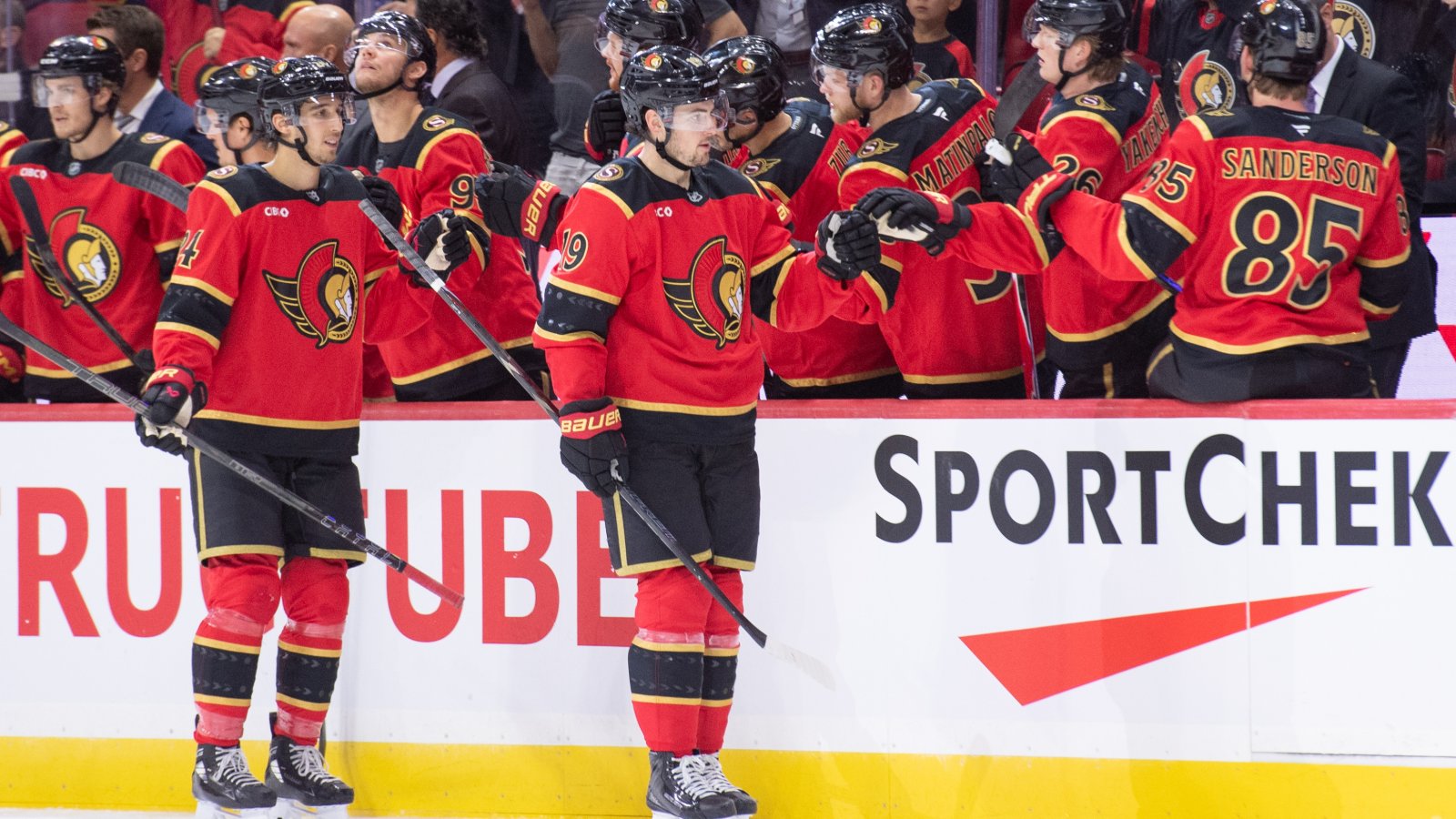
8 playersFollowing the Ottawa Senators’ 7-4 win over the New York Rangers, the team has picked up their 16th point of the season on the strength of an 8-4-0 record through 12 games.
The team will depart Sunday for a western road trip with a chance to do something special.
With three games left before the end of the month, the Senators need two wins to reach 10. According to Hockey-Reference’s database, only 19 teams in the history of the NHL have amassed 10 wins in October. Of those teams, only three have gone on to miss the postseason following their respective hot start - the 2013-14 Toronto Maple Leafs, the 2015-16 Montreal Canadiens, the 2017-18 St. Louis Blues.
In other words, 84.2 percent of the teams that strung together 10 wins in October have gone on to reach the postseason. History is encouraging, but it is not a certainty. It also reminds us that monumental collapses can undo the successful groundwork a team builds early in the season.
For the Sens, however, the organization has to be thrilled with their early results for several reasons. Although the organization has reached the postseason in each of its first two seasons under head coach Travis Green, second-half surges helped the team overcome significant point deficits in the standings to get there.
Ottawa did not get its 10th win of last season until November 20th. The season prior, it wasn't until November 27th.
It is also important because the team has not played particularly well.
Injuries have ravaged their blue line in October.
The Senators lead the league in the most defencemen used during the 2026–27 season, with 10 different defencemen having already dressed for a game. It is not just the quantity of defencemen getting hurt; it is also the quality.
The captain, Thomas Chabot, has missed the past three games with an undisclosed upper-body injury.
Last season’s top pairing of Jake Sanderson and Artem Zub have only been able to play in three games together. Zub was still recovering from the lower-body injury that he sustained in the first game of the playoffs, and Sanderson reaggravated a lower-body strain that he suffered in training camp during the first period of the Senators’ first game.
Third pairing defenceman Nik Matinpalo missed two games with an upper-body injury after he was sent headfirst into the boards by Anthony Manta during the Senators’ game against the Devils on October 12th.
The injuries have forced Travis Green and assistant coach Nolan Baumgartner to constantly shuffle bodies while trying to be mindful of the strengths and limitations of who is available. Sometimes, like during their October 10th game against the St. Louis Blues, in which they had to dress three rookie defencemen in their lineup, there is no ability to shield their young defencemen from tougher matchups. For the most part, however, they have done an excellent job insulating and playing to the strengths of who was on the ice. For example, Carter Yakemchuk has the eighth-highest offensive zone start rate among NHL defencemen this season, per Natural Stat Trick. In theory, the advantage not only plays to the fact that he has strong offensive aptitude, but also protects him against the defensive warts that many young and developing defencemen often experience.
Injuries have affected the pairings and ordering, so the Senators’ five-on-five numbers have predictably suffered.
After being one of the top-five teams in the league in several important shot and goal metrics, the Senators have spent the majority of the season at the league’s bottom.
Through their first nine games, the Senators generated 44.01 percent of the shots (CF%, 27th), 46.15 percent of the shots on goal (SF%, 28th), and 45.39 percent of the expected goals (xGF%, 26th) per Natural Stat Trick.
Losing that total shot and expected goal share is undesirable, but the key distinction is that the Senators still did an excellent job suppressing shots given the circumstances.
The Senators allowed the 10th-lowest rate of shots on goal (SA/60) and 12th-lowest rate of expected goals (xGA/60).
The issue is that the Senators’ shot and expected-goal rates ranked in the bottom five. Much of the attention in October focused on the Senators’ lack of offence, but offence flows from execution in the defensive zone. If the defence struggles with efficiency in retrievals and puck movement, the likelihood of success in zone exits, puck transportation through the neutral zone, and clean zone entries will suffer.
Without one of those facets, it will be difficult to generate offence. Without all three, good luck.
Tim Stützle deserves credit for his production to start the season, but Linus Ullmark is the principal reason why the Senators have stockpiled points.
Ullmark famously arrived at training camp last season saying he couldn't return this season feeling the way he did then. A notoriously slow starter since joining the Senators, poor performance in the initial stages of the season has characterized Ullmark’s tenure. To his credit, his play improved as the season wore on in each of the last two seasons, and against Carolina in the playoffs, he was Ottawa’s best player.
Since his mental health battle came to the forefront last season, Ullmark has been fantastic. The organization has also gone to great lengths to insulate the goaltender and help him feel more comfortable, and the numbers reflect that.
It was naive to believe that Ullmark could replicate his postseason numbers, but all eyes were on the Swedish goalie.
He has been exceptional.
Only the Dallas Stars’ Jake Oettinger has a higher goals saved above expected mark (10.33 GSAx) than Ullmark’s 10.30.
His performances have kept the Senators in games they had no business winning.
It is reasonable to expect some regression in Ullmark’s metrics. That said, if he can play at a league-average level or better, the Senators are in great shape - especially since the team’s metrics in light of Jake Sanderson’s return to health have improved markedly.
Here is a contrast in the Senators’ first nine games and last three games at five-on-five:
- First 9 GP: 44.01 CF%, 46.15 SF%, 45.39 xGF%, 46.31 CF/60, 21.10 SF/60, 2.07 xGF/60
- Last 3 GP: 53.62 CF%, 57.26 SF%, 52.57 xGF%, 64.87 CF/60, 31.12 SF/60, 3.01 xGF/60
It is a small sample, but the Senators are exiting their zone much more efficiently and sustaining play in the offensive zone. The result is a bigger offensive spike, with the Senators scoring 13 goals in their past three games. Although the Senators only scored twice against San Jose, it was arguably one of their best games in terms of the chances they generated.
With Thomas Chabot skating with the team and Travis Green confirming that the veteran defenceman will not only travel, but is expected to play on this western road trip, a healthy Senators blue line will pay dividends.
A healthy Ullmark and a normalization in the team’s underlying metrics will represent a challenge for any opponent.
How You Drew It Up
You have heard of ‘Painting with Bob Ross’, but have you heard of ‘Drawing with Ridly Greig’?
According to Natural Stat Trick’s data, Ridly Greig has already drawn a league-leading 13 penalties this season. It is four more than the next closest player, Garnet Hathaway, with nine.
Earlier this week I covered Ridly Greig’s “nail gun” style, but this statistic speaks to how well he is playing his agitating role. And keep in mind, he missed the first two games of the season while serving a suspension for sucker-punching Carolina Hurricanes defenceman Sean Walker during game four of their playoff series.
Greig has established himself as one of the league's preeminent and effective pests.